
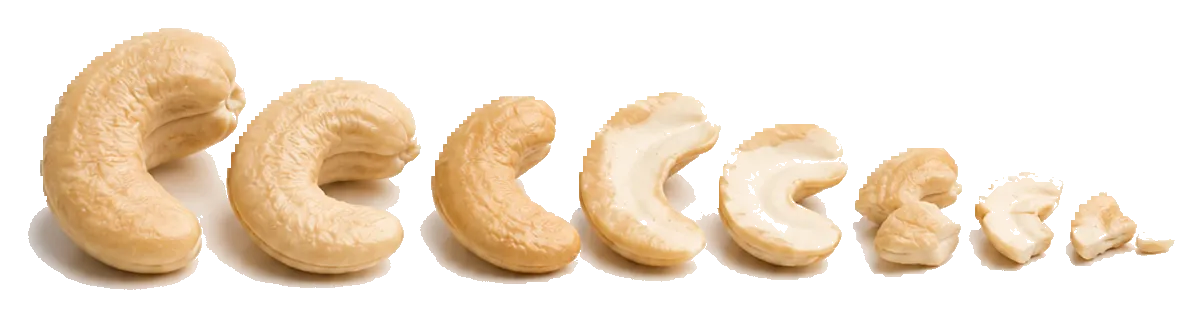
The W number is a size grade, not a quality grade. W320 means roughly 320 whole white kernels to the pound, so a lower number is a bigger nut. Pick the grade by how the cashew is seen and eaten in your final product, then pay for size only where size is on show. Buyers who skip that step tend to overspend on size nobody notices, or put a small kernel in a pack that needed a big one.
What the “W” and the number mean
W stands for whole white: a clean, undamaged kernel with no scorching or serious colour defects. The number is the count of kernels per pound (454 g). Fewer kernels per pound means each one is heavier, so the grade doubles as a rough size chart.
| Grade | Kernels per lb | Size | Best use | Price tier |
|---|---|---|---|---|
| W180 | 170-180 | Extra large, “king” | Showpiece gifting tins, garnishing, premium single-origin lines | Highest |
| W210 | 200-210 | Large | Premium retail packs, hotel amenity bowls | High |
| W240 | 220-240 | Large | Attractive retail and hospitality snacking | High-mid |
| W320 | 300-320 | Medium, most traded | The default for most kitchens and packers; best size-to-value balance | Mid |
| W450 | 400-450 | Small | Cooking, blending, coatings, mixes where size is invisible | Lower |
W320 is the global workhorse and usually the most available grade at the tightest price. W180 and W210 carry a premium that only pays off when the buyer can see the difference in the pack or the bowl.
Whole vs splits, butts and pieces
Whole grades cost more because the yield of unbroken kernels is lower. That premium buys nothing once the nut is chopped or ground, or simply out of sight in the finished product.
- Splits (JH / cashew splits): kernels cleanly halved along the natural line. Ideal for kaju paste, sweets, and any recipe that gets blended.
- Butts (JB): kernels broken across, slightly smaller than splits. Good for bakery, cereal, and coatings.
- Pieces (LWP - large white pieces, SWP - small white pieces): graded fragments. The cheapest route to cashew flavour in granola, chocolate, praline, and cashew butter.
If your process breaks the nut anyway, buy it already broken. There is no reason to pay whole-grade money for W320 that ends up crushed into a cookie dough.
Raw vs roasted
Buy raw kernels when you roast, fry, spice or coat in-house. You control the oil, salt and roast colour, and you avoid paying for a process you repeat. Buy roasted and salted only for direct snacking lines where you have no roasting station. Roasted stock also has a shorter shelf window once oils are exposed to heat, so match order size to turnover.
What to check on intake
The label tells you the grade, not the condition of the batch. On arrival, check:
- Colour should be a uniform pale ivory. Scorched, dark or heavily blotched kernels signal over-processing or old stock. Cashews are graded down to “scorched” (SW) and “dessert” (DW) tiers for exactly this reason.
- Moisture shows in the bite: kernels should snap, not bend. Soft or chewy nuts mean high moisture, which invites mould and cuts shelf life. Good stock sits around 3-5% moisture.
- A whole grade should be mostly whole. A W320 carton heavy with splits and dust is count-creep, covered below.
- The smell should be clean and slightly sweet. Any paint-like or rancid note means the oils have turned.
Origin: India vs Vietnam
Most of the world’s cashews are grown in West Africa and processed in India and Vietnam, the two dominant kernel exporters. Vietnam runs high-volume mechanised processing and is strong on consistent W320 at scale. India has a long hand-processing tradition and is known for careful grading on the larger W180-W240 sizes. Neither is “better” outright. For big, uniform gifting kernels, Indian W180/W210 is usually the better buy; for reliable, well-priced W320 volume, Vietnam is hard to beat. Ask your supplier which origin a given lot came from, because it explains price gaps that grade alone does not.
Match the grade to the job
| Application | Sensible grade |
|---|---|
| Gifting tins, premium garnish | W180 / W210 |
| Retail snacking packs, hotel bowls | W240 / W320 |
| General kitchen and packing | W320 |
| Sweets, kaju katli, cashew paste | Splits |
| Bakery, cereal, coatings | Butts / pieces |
| Cashew butter, praline, inclusions | Pieces (LWP / SWP) |
How count-creep shows up
Count-creep is when a carton labelled one grade quietly drifts toward a smaller, cheaper one. Watch for a W320 bag that runs closer to 350-380 kernels per pound, or a rising share of splits and broken kernels inside a “whole” grade. Size that wanders between reorders is the same problem showing up over time. A quick count of a weighed 100 g sample tells you the true grade in two minutes, and counts that hold order to order say more about a supplier than any single carton.
Not sure which grade fits your use? Ask us and we’ll point you to the most cost-effective option for how you actually use the nut.